
It’s there, standing somewhere. In the corner. Often in my room. Sometimes, elsewhere. I’m alone on the gallery in a nightclub watching bodies move below. It’s warm, but the air is heavy, all the moisture evaporating off people’s skins. It’s back in the corner again. Since I’ve seen it for the first time, Phantom Thread (2017) has left me with this feeling. Everything slightly off-kilter as I’m finding my way home through a quiet park that felt lived in six months ago. Face flushed, it’s the tingling that might have come from one glass of red, or the sight of the person that I assured myself wouldn’t be there but hoped would. Maybe I have a fever.
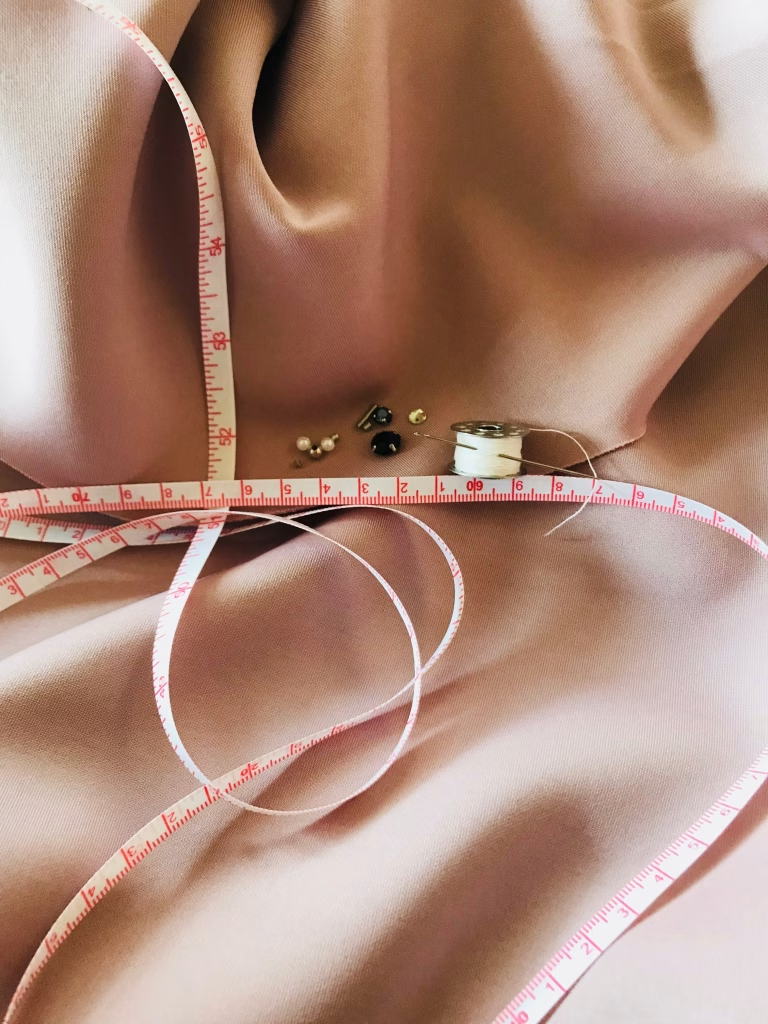
Paul Thomas Anderson’s film induces an entrancing dizziness. The pirouetting sensation of resting your head on a cold pillow in a faintly drunken haze. We’re in 1950s London, spending the days with esteemed haute couture designer Reynolds Woodcock (Daniel Day Lewis), swallowed into seductive montages that sew hours of measuring tape stretches and needle threads into hedonistic seconds. Even Woodcock’s entrenched morning routine escapes its own rigidity. A brush scratching shaving cream into pores, the muffled rustle of a sock slipping on. Prickly sound design (which feel like one of those scalp massagers) accompanied by the spiralling staircase of Jonny Greenwood’s piano chords elevate this creamily edited scene into a deeply pleasurable audio-visual experience. The exactness of Woodcock’s ritual is an indicator of the insulated world the impenetrable protagonist has built for himself, something Anderson and Day-Lewis establish early on, at least subliminally. And yet, it never feels procedural. Phantom Thread’s lens thirstily fantasises spaces, and the characters that float in and out of them.
Because of this, it feels inadequate to characterise the film as anything other than fairy-tale. Part of this is indebted to the dreamy aura of its world, which at times seems to slyly invite you to glide into the frame when its characters aren’t looking. Nonetheless, most of its mysticalness comes from centre-stage relationship between Reynolds and Alma (Vicky Krieps).
Daniel Day-Lewis’ masterful realisation of Woodcock’s character is only further proof of that which everyone already knows. The performance is decorated with sensual elocution as well as an arsenal of (often giggle-sparking) grimaces. Still, it never succumbs to feeling like a bloated caricature, always retaining the sense that it’s constructed from the inwards out. Always bursting with the impression that beneath the ruthless remarks and emotional-detachedness sits a boy clawing for control, a boy (in one moment, very literally) haunted by the ghost of his mother. His entire profession seems to be a yearning towards finding the lost wedding dress he crafted for her, once upon a time ago.
This Oedipal struggle is where Phantom Thread earns its title of a fairy-tale, albeit less in the sanitised cheeriness of Disney and more in the twisted traditions of Grimm and Christian Andersen. Reynolds and Alma’s bond begins in the realm of fantasy: he loves her for her submission to his gaze, she loves him for his voracious worship of her. Once it becomes apparent that Reynolds is unable to overcome himself, Alma, fiercely played by Krieps with unconformity and cunning, rejects not only becoming a disposable object of infatuation, but also being shut out from his closely guarded world. Through a conniving scheme of control and manipulation, Alma reduces Reynolds to infantile states where she can reassert control over their relationship through the display of maternal caretaking.
The sado-masochistic conclusion of Phantom Thread is equally romantic and repelling because it resists the absolutisms that we expect from romance narratives. Characters do not radically self-actualise and set free their ghosts, nor is “right person, wrong time” always a sad ending. Rather, Anderson seems to suggest that there never is a “right time”; that love tends to be taken rather than waited for. As in the film’s finale, two imperfect people dance with each other. Sometimes, they may leave claw marks.
Photo by pina messina on Unsplash